The problem
Where does dust come from on a building site?
Demolition
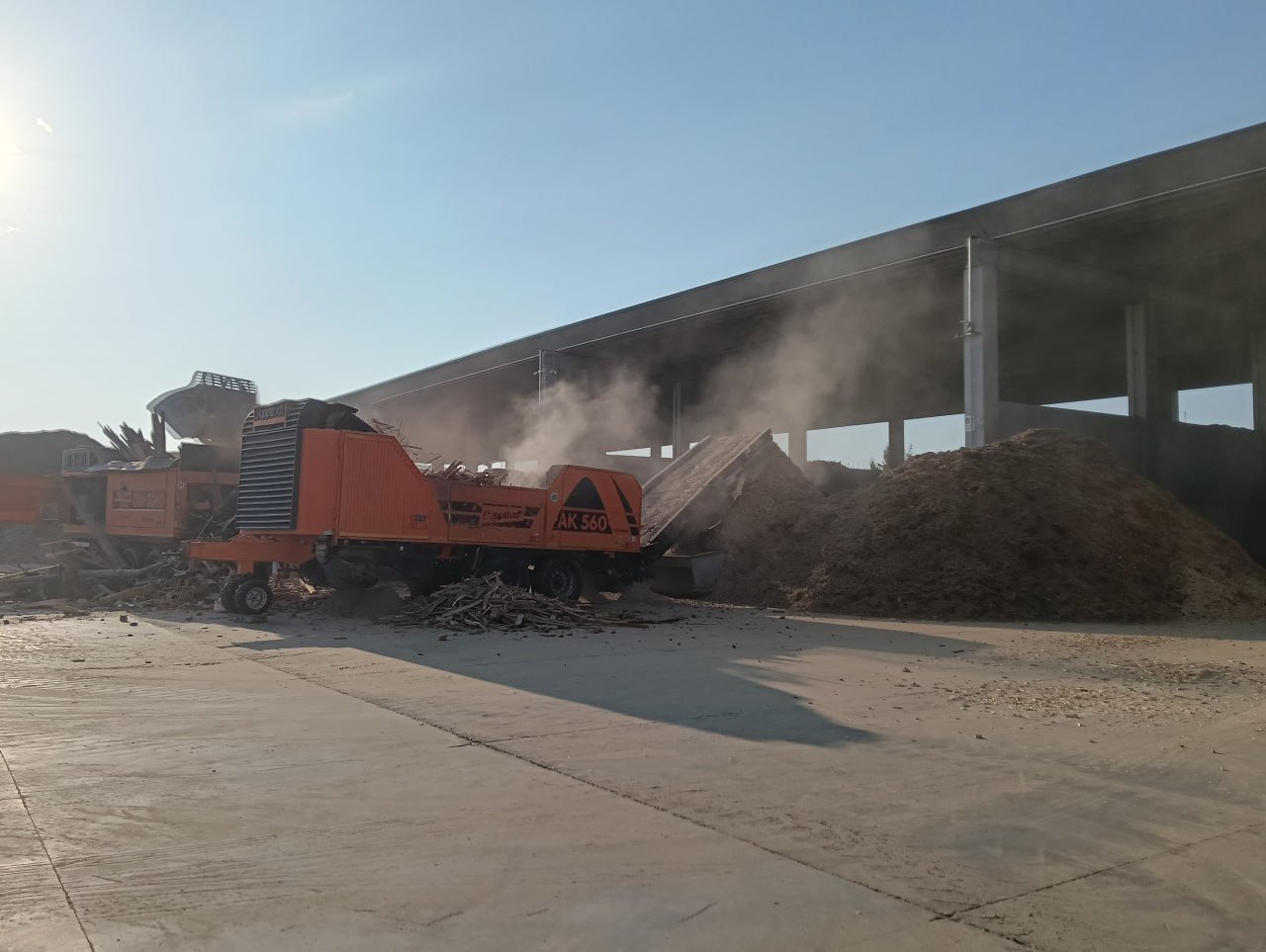
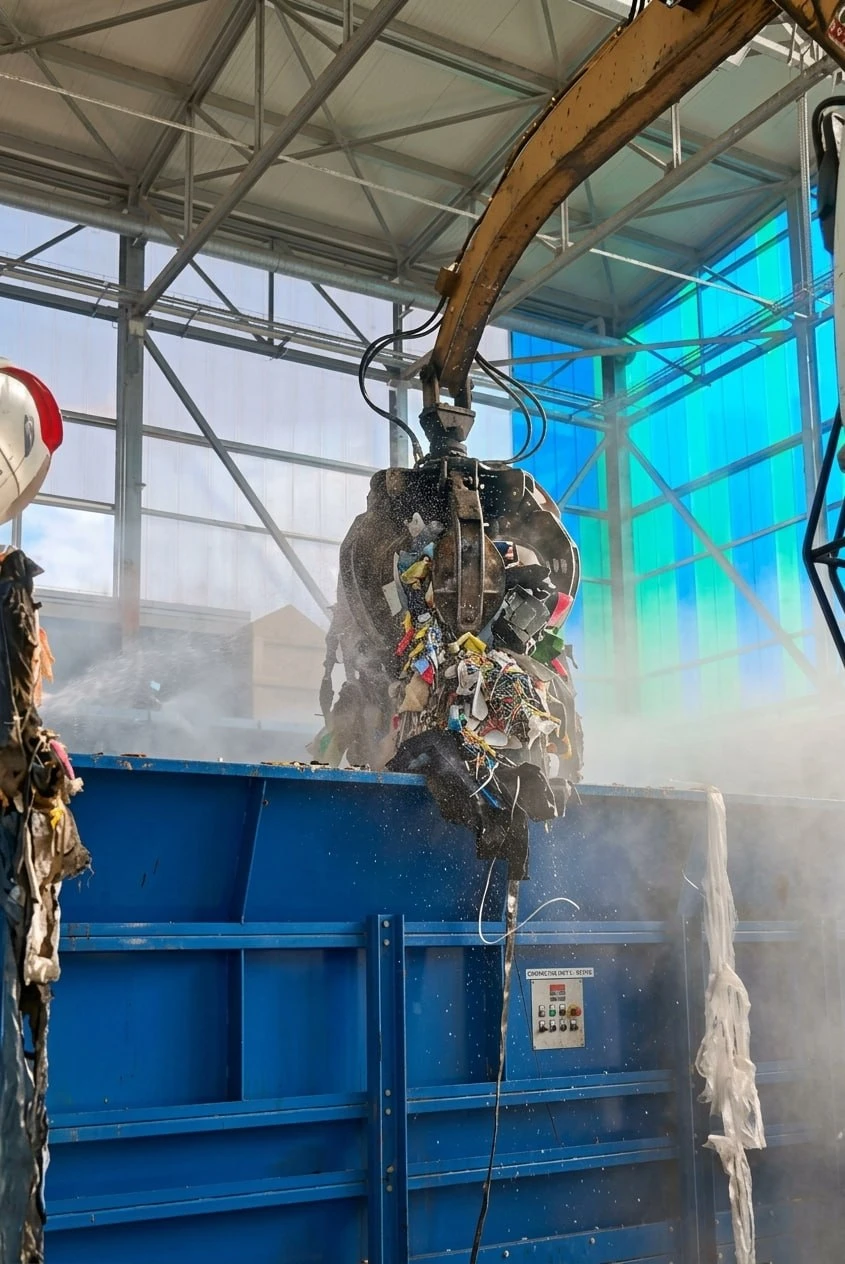
When the demolition grapple springs into action, the structure shatters and a large amount of dust is released into the air. It is precisely at the point of origin that action must be taken. Conrad dust suppression cannons allow the range, flow rate and direction of the spray to be precisely adjusted to intercept the dust cloud directly at the demolition front.
Thanks to controlled misting, the particles are captured and brought back down to the ground, improving visibility on the construction site, reducing dispersion into the environment and increasing comfort for operators and residents in the surrounding areas.
Loading, unloading and internal traffic
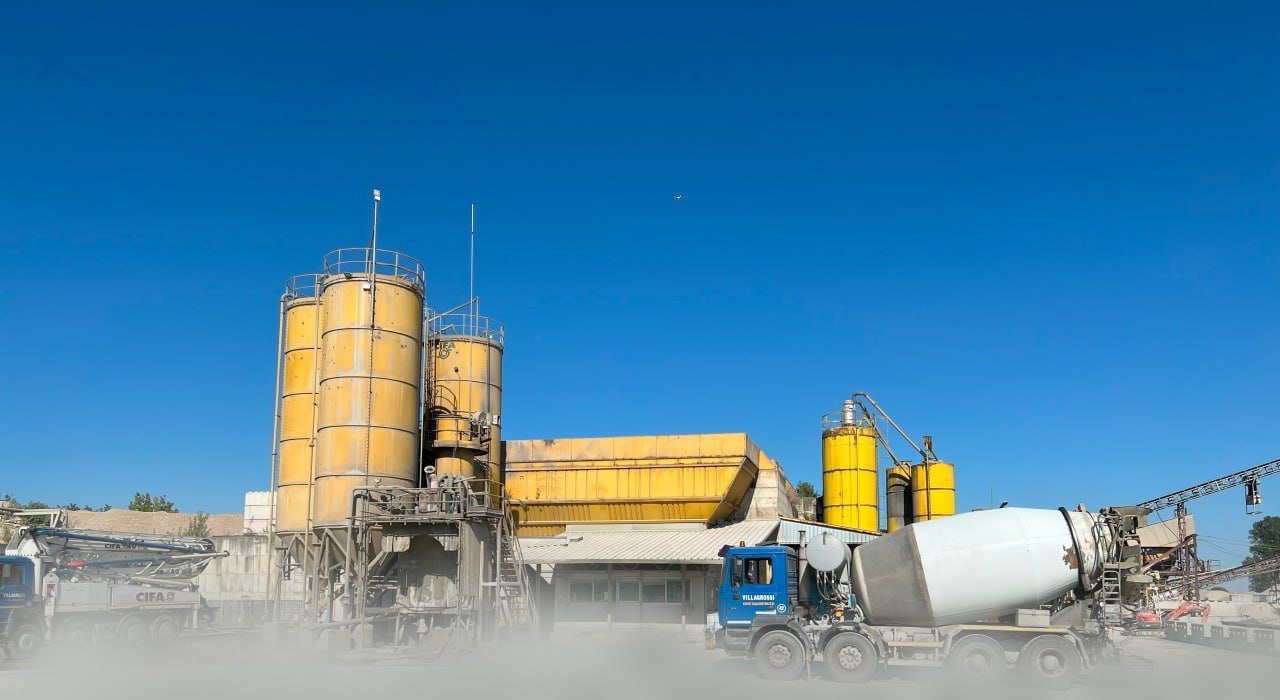
Material-handling operations are among the main sources of dust emissions on construction sites, in quarries and at recycling plants. Wheel loaders, hoppers, conveyor belts and lorries continuously generate dust during loading, unloading and transit.
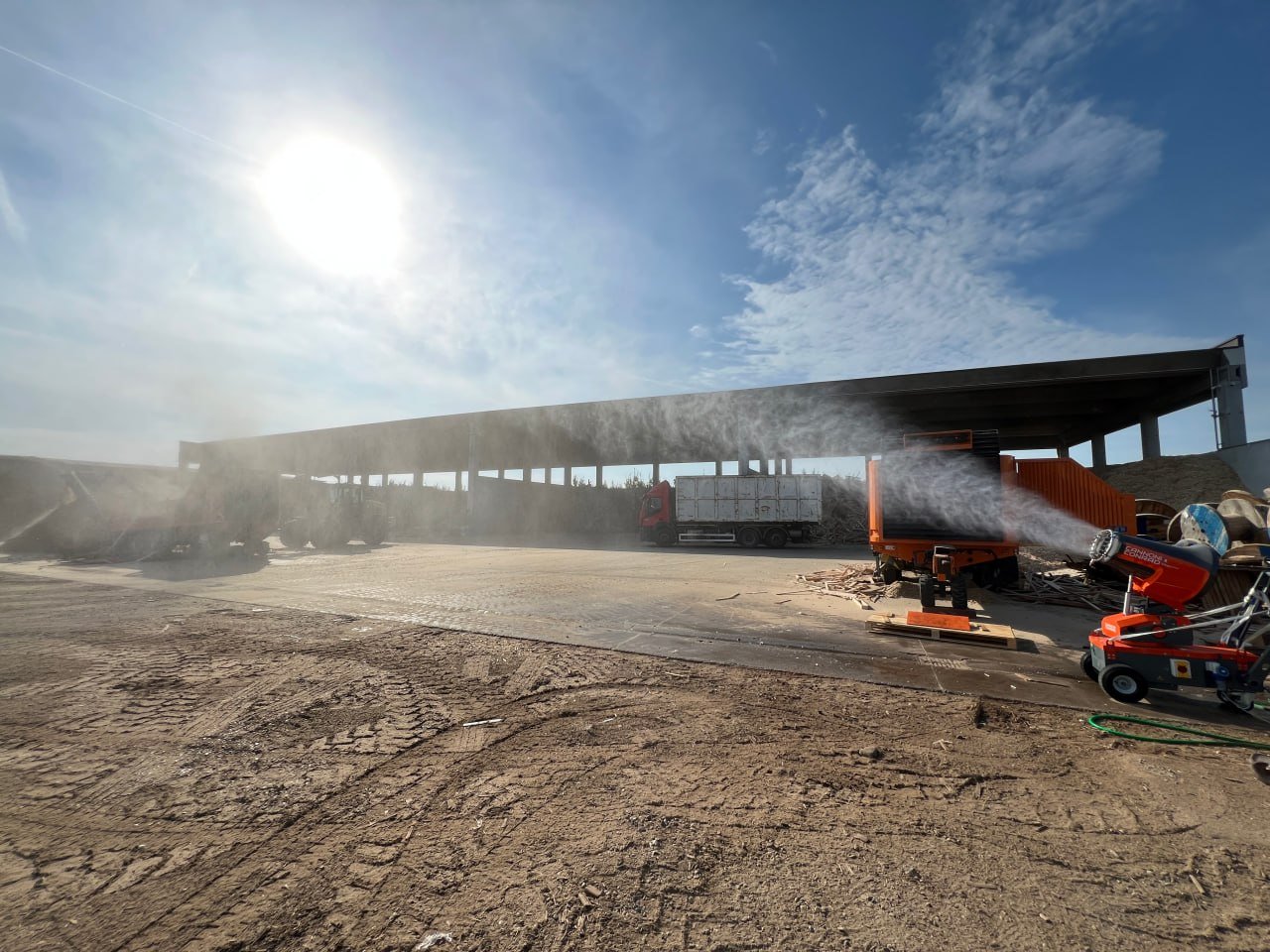
The Titan series cannons, featuring automatic rotation of up to 230°, enable large areas to be covered from a single installation point, keeping yards, service lanes and operational areas under control. The uniform distribution of the mist reduces dust dispersion throughout the entire logistics cycle.
Heaps, screens and sheds
Screening, storage, composting and material processing activities can generate dust and odour emissions for many consecutive hours. In such situations, it is essential to take consistent and targeted action.
The Conrad cannons in the Hydra series, thanks to their telescopic pole, allow mist to be sprayed from above and capture dust particles before they disperse into the environment. For more specific areas, such as discharge outlets, transfer points and canopies, fixed misting systems create effective barriers of atomised water that limit the spread of dust and odours at source.
The combination of mobile cannons and fixed systems ensures comprehensive coverage of the plant, improving operating conditions and helping to meet environmental requirements.
How it works
How nebulisation works
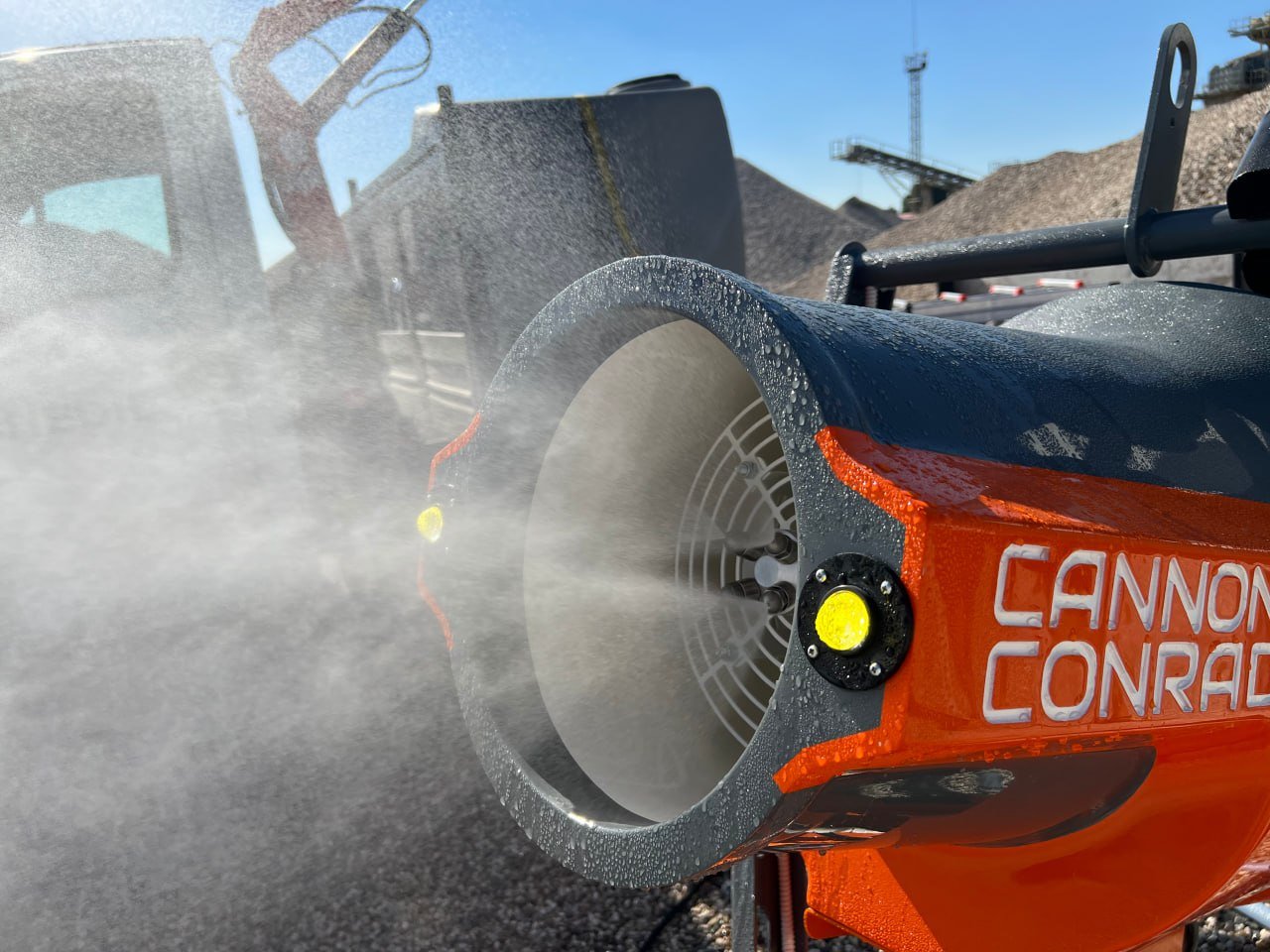
The built-in pump generates up to 60 bar of pressure and feeds the nozzles directly, without requiring any inlet pressure from the mains water supply. The water is broken down into millions of microdroplets, which the fan directs towards the source of the dust, increasing the efficiency of dust suppression whilst minimising water consumption.
Fine drizzle, no puddles
The aim is not to wet the material, but to capture airborne dust particles. This is why Phoenix and Titan use a high-pressure pump with three ceramic pistons, which produces a fine, uniform mist.
With a flow rate of just 8 litres per minute, there is no need for large water supplies: a standard ¾" connection or a simple storage tank is sufficient. Less water on the ground means less mud, fewer puddles and greater operational convenience.
The range covers the right area
Every construction site and every plant produces dust in different places. That is why the spray range must be adapted to the job, not the other way round.
On Phoenix models, it can be adjusted directly from the control panel, from approximately 10 to 25 metres on the Plus version and up to 35 metres on the Power version. Titan adds automatic rotation of up to 230° to cover large areas with a single positioning. Hydra combines a 5-metre telescopic boom with a reach of up to 40 metres, allowing work to be carried out from above and hard-to-reach areas to be accessed.
For particularly large areas, the LC and C-series semi-automatic water cannons are available, capable of reaching distances of up to 70 metres.
Where there is no water or electricity
Not all building sites have water and electricity connections. Hydra was created to address these situations.
The system comprises a Phoenix Power unit mounted on a 5-metre telescopic tower, a 1,000-litre tank and a 10 kVA generator, available in either petrol or diesel versions. The entire unit is mounted on a forklift-accessible base that can be easily moved using a forklift or loader.
The result is a fully self-contained unit, ready for use anywhere and capable of covering areas of up to approximately 4,200 m² without the need for external connections.
The rules
What do the regulations on dust require?
Construction site dust poses a risk to workers and a problem for local residents. Three guidelines apply to almost all construction sites.
Operator safety
Legislative Decree 81/2008 requires that exposure to dust be assessed as a chemical agent and reduced at source. Respirable free crystalline silica, found in sand, concrete and bricks, is classified as a carcinogen under Legislative Decree 44/2020, with a limit value of 0.1 mg/m³.
Air quality
Legislative Decree 155/2010 sets a daily limit of 50 µg/m³ for PM10, which must not be exceeded more than 35 times a year. In municipalities where this limit is exceeded, construction sites are subject to dust control measures, ranging from wetting the tracks to suspending work on critical days.
Site regulations
Regional guidelines and local by-laws governing demolition work, quarries and waste facilities require that materials, rubble and access routes be wetted down and that dust be kept away from residential properties. The dust suppression cannon is the equipment that carries out these tasks using a measured amount of water and requiring just one operator.
Models
Which gun for which shipyard?
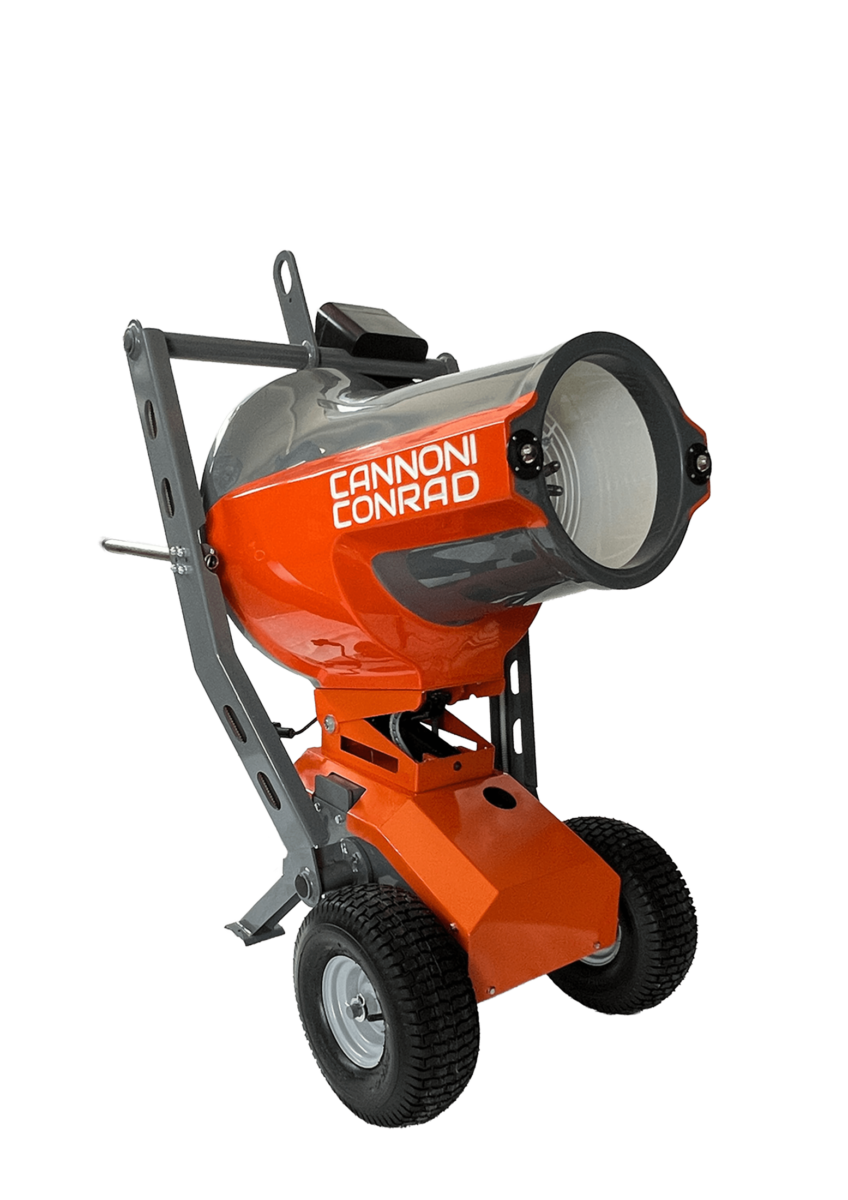
Phoenix and Titan, in their Plus and Power versions, work as a team: you put one in each area where dust is produced. Hydra is for places where there’s no water or electricity.
Conrad Phoenix Plus
- Connection: 220 V, CEE 16 A
- Water consumption: 8 l/min
- Tilt: + 45° electric
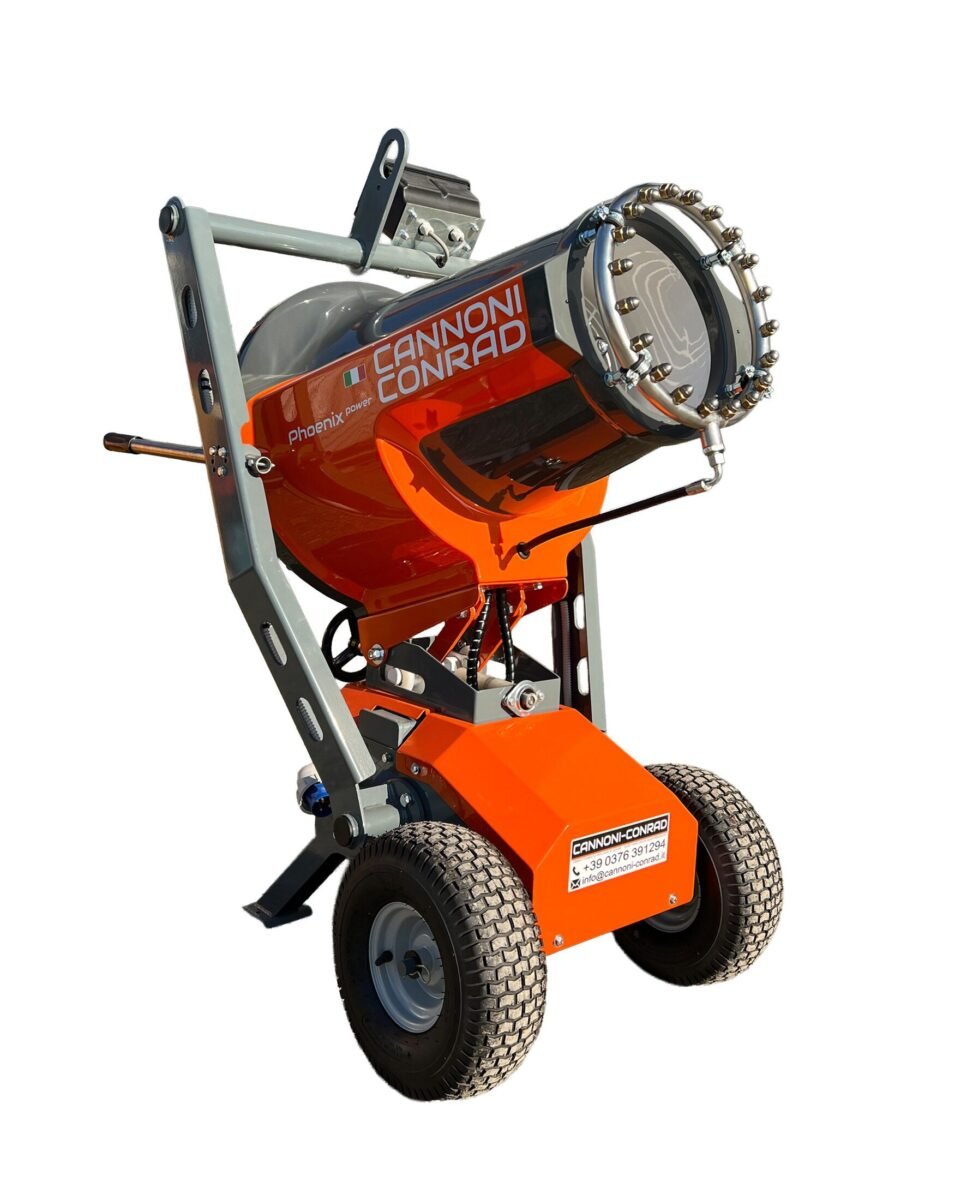
Conrad Phoenix Power
- Connection: 220 V, CEE 16 A
- Water consumption: 8 l/min
- Nozzles: 20
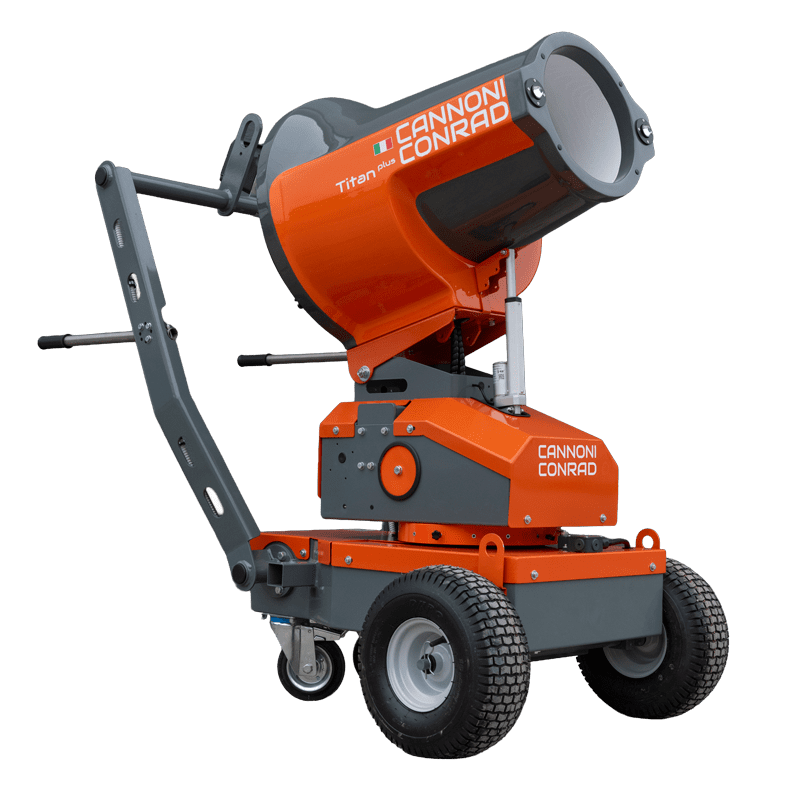
Conrad Titan Plus
- Connection: CEE 32A
- Water consumption: 8 l/min
- Rotation: 230° automatic

Conrad Titan Power
- Connection: CEE 32A
- Water consumption: 8 l/min
- Rotation: 230° automatic
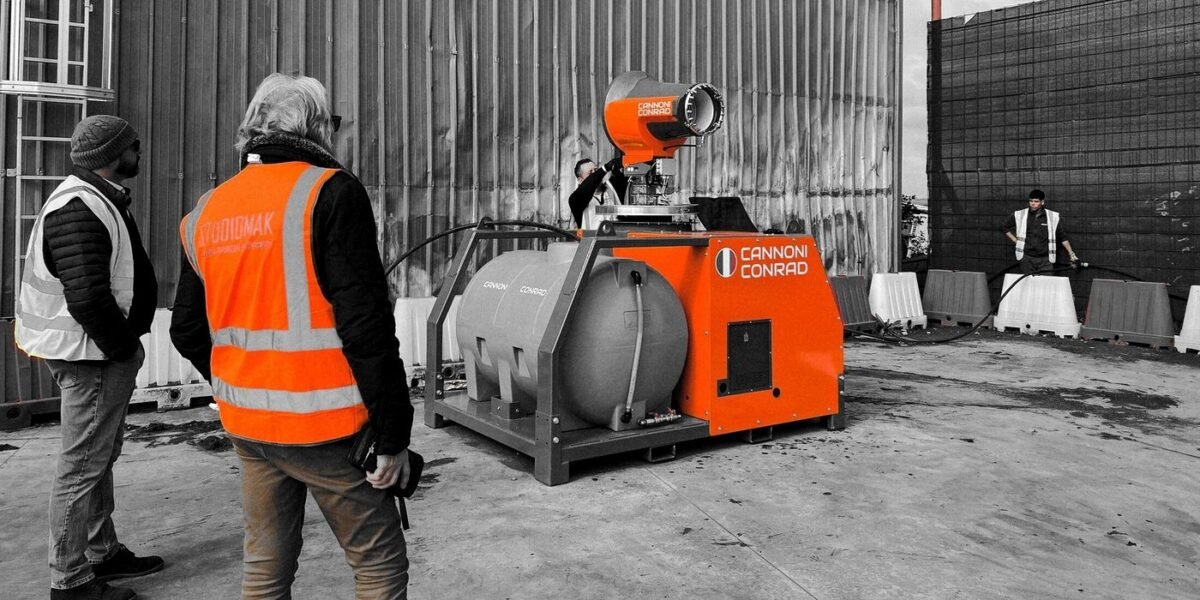
HYDRA Autonomous Station
- Built-in generator: 10 kVA, petrol or diesel
- Water tank: 1,000 litres
- Water consumption: 8 l/min
Not sure which one to choose? The calculator tells you the model and number of cannons for the area of your site.
Calculate coverage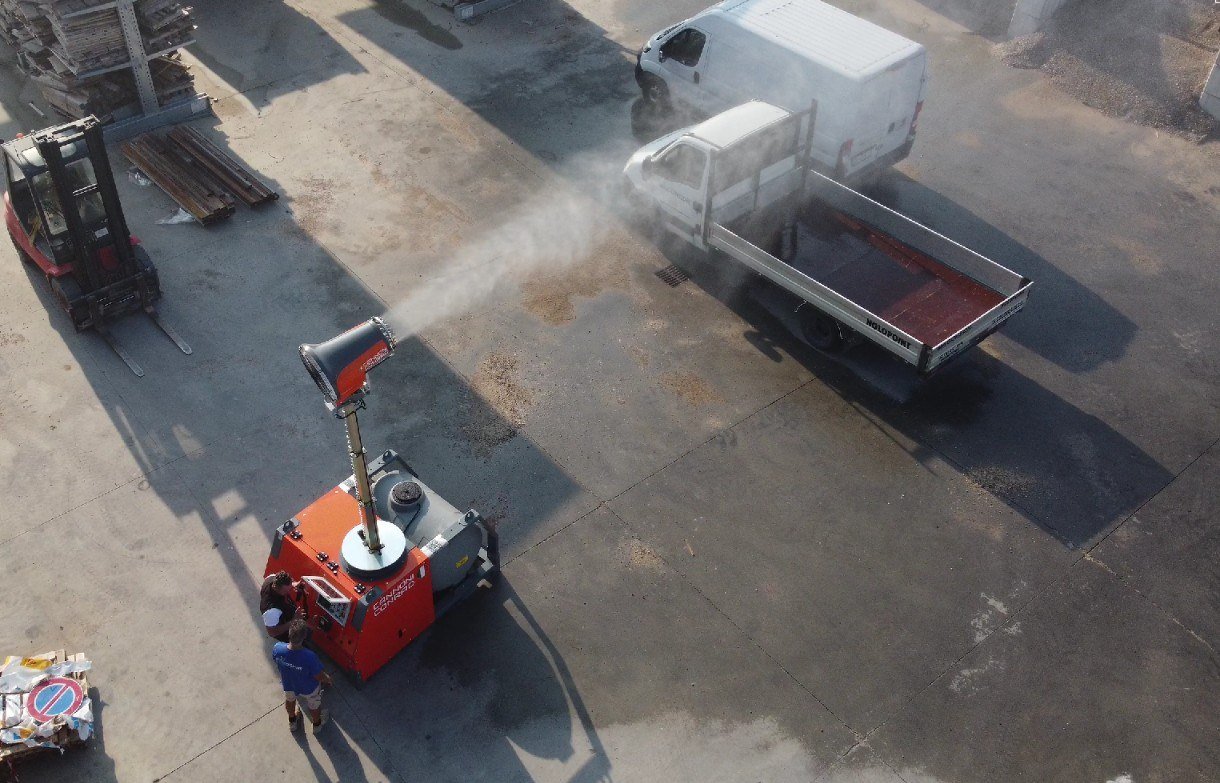
Frequently Asked Questions
Questions about dust suppression
How much water is needed to suppress dust?
8 litres per minute for the Phoenix Plus, Phoenix Power, Titan Plus, Titan Power and Hydra: 480 litres in one hour of operation, and four Phoenix units together consume 32 litres per minute.
Do you need mains water pressure?
No. The Phoenix and Titan have a 3-piston pump that delivers water at 50–60 bar from a tank or a standard ¾-inch connection. The Hydra has an on-board tank.
What type of electricity is required on a building site?
Phoenix Plus and Phoenix Power operate on 220 V single-phase power with a 16 A CEE plug, with installed power ratings of 3 and 4 kW. Titan Plus and Titan Power have a 32 A CEE socket. Hydra has a 10 kVA on-board generator.
Does the cannon work even when it’s windy?
The wind blows the cloud of droplets away: this is why the range is adjusted and the cannon is aimed at the point where the powder is scattered. During the site survey, we select the model and position based on the powder, range and wind conditions at the site.
How much noise do they make?
70 dB, the same figure for Phoenix Plus, Phoenix Power, Titan Plus, Titan Power and Hydra.
How much does dust suppression using a water cannon cost?
It depends on the model and accessories: the Phoenix Plus, Phoenix Power, Titan and Hydra station all have different prices. Tell us about your site and we’ll get back to you with the model and a quote within one working day – including hire options.
Phoenix Plus, Phoenix Power, Titan Power and Hydra are also available for hire, with on-site commissioning and operator training provided.
Dust suppression cannon rentalThe Smart range: Phoenix and Titan with an adjustable spray range of 10 to 35 metres, Plus and Power, 220 V and 8 litres per minute.
Discover the smart lineFixed misting systems operate on conveyor belts, in storage bays and in warehouses, using only water pressure.
Misting systemsQuote
Request a quote
Use this form to request information about a dust suppression cannon or a quote straight away for the dust you need to suppress on site. We’ll contact you as soon as possible.
Via Novellara 1 46100 Mantua, Italy
Open in Google Maps